Thursday, January 10, 2013

Gigabyte’s ultra-small desktop PC makes the Mac Mini look like a giant


Due for release around April, Gigabyte’s new, as-yet-unnamed desktop computer is smaller than most paperback novels, yet supports up to Core i7 processors.
Although still in pre-production, Gigabyte’s newest mini PC debuted at CES, packing a lot of hardware into a tiny chassis. At 0.3 liters (or 10 fluid ounces) and 4” x 4” across, it’s a bit reminiscent of the Genie from Aladdin: “Phenomenal cosmic powers… itty bitty living space!” For purposes of comparison, the much-beloved Mac Mini measures 7.7 inches square, almost twice the size.
The unnamed Gigabyte model builds upon the Intel NUC, a mini-PC platform developed by Intel, but adds several compelling perks. Most notably, there’s now support for i3, i5, or i7 Intel Core processors, as well as USB 3.0 ports. Up to 8GB of RAM and up to a 256 GB SSD provide the finishing touches for a rather robust system.
Additionally, the teacup-sized desktop boasts a brushed-aluminum body and low-power design, making it a green product—and therefore potentially attractive to LEED-certified buildings and businesses looking to round out their environmental credentials. Although Gigabyte has yet to set a pricetag, they have hinted that the entry-level model should be competitively priced, according to Liliputing.

Read more: http://www.digitaltrends.com/

The revolution will be 3D printed

makerbot at ces
Makerbot is the face of the emerging 3D printing market. At CES it introduced us to its latest machine, the Replicator X2, and revealed it was releasing its Thingiverse API so developers can create apps to help us create products. It’s very meta, and very cool.
ces-awesome 3D printing has gone from niche hobby of the ultra-creative to breakthrough technology that is increasingly approachable, and is revolutionizing the design and production industries. At the helm of this revolution is Makerbot, which took home the award for “Best Emerging Tech” at CES 2012. And Makerbot is back – and bigger – this year. Despite the company’s massive growth and 3D printing prestige, the team is sticking to its roots.
makerbot bre pettis“Makerbot is an innovation company,” CEO Bre Pettis tells us. “We innovate ourselves to empower other people to innovate. Our mission is to jumpstart the next industrial revolution.”
Part of that mission will be accomplished by the Makerbot Replicator 2X, the company’s latest release. To offer a little perspective, Pettis says that while the Replicator 2 (the company’s previous release) is super accessible and user-friendly to anyone with product design dreams, the Replicator 2X is for the mad scientist types out there, ready to really dive into 3D printing.
makerbot replicator x2The 2X uses ABS Filament, a plastic designers’ favorite, but is more difficult to work with than PLA (which the Replicator 2 uses). The X2 features a heat-capturing hood that makes sure that the plastic doesn’t curl or crack while its cooling. Other improvements include a re-engineered extruder that makes loading easier and the ABS-feeding process smoother, causing less wear and tear on the unit.
Also worth noting: the X2 allows you to load two different colors. Things just got real. The 2X will begin shipping in mid-March and cost $2,799 (the Replicator X costs $2,199, for comparison).
The 2X isn’t all that Makerbot brought to CES. A new addition to its Thingiverse platform, where people can share their creations or find things to make, is being opened up to the public. The brand is also unlocking its Thingiverse API to allow developers to create apps for the Makerbot ecosystem. “It’s a little Inception-like,” Pettis said. “We have an API for our platform that allows people to create applications to create things… and then we have the new Customizer App that allows users to customize those things.” For instance, if you want to create an iPhone case you see on Thingiverse, you can choose how thick the lines on the triangles you have patterning the case are. This is product personalization to the Nth degree.
So, to connect all those dots, Makerbot is allowing you to make things that help you make things that you can then make into very specifically customized things. And around and around we go.
As to the supposed hardware slump CES and the electronics industry is said to be in, Pettis says it’s all part of a cycle. “When things change, people freak out, and one of the things we’ve seen at CES in the last four years is that big players are losing touch with being able to connect with their customers and consumers. But you’re seeing all these small innovators coming out – this is the year of the entrepreneur at CES.”
“People want to kick off the next industrial revolution – but that won’t work unless you make it easy for people to change the world.”

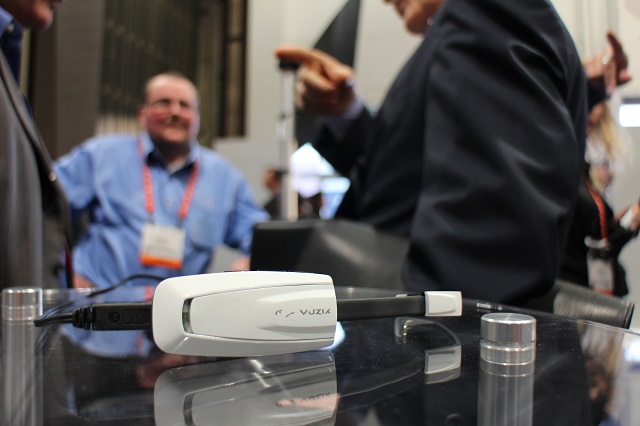
man’s Google Glass: the Vuzix M100

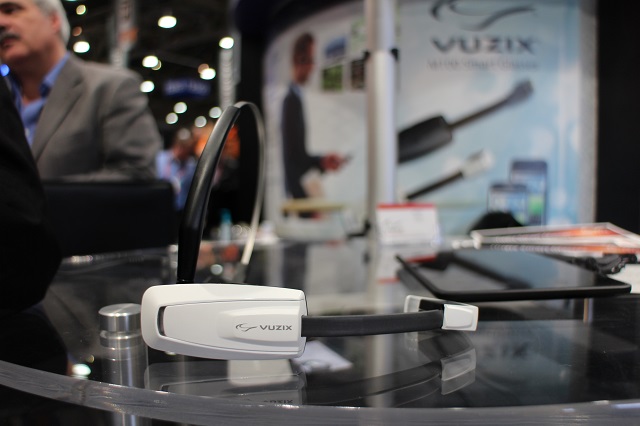
vuzix m100When Google first premiered Project Glass last year, it inarguably struck a chord. The augmented reality device is but-yet a prototype, only making it into the hands of developers and a handful of elite “beta testers” (looking at you, Diane Von Furstenburg and co.).
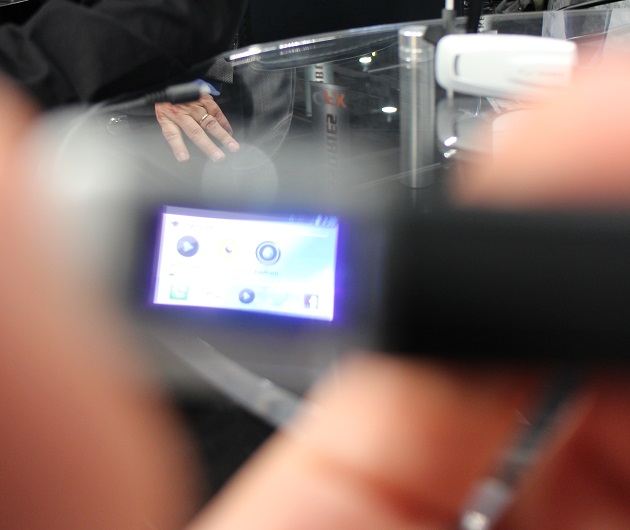
Despite the impossible-to-kill hype around this project, Google has more or less been the only pioneer seriously attacking the wearable interface market – or at least the loudest. But there are other, smaller, quieter cotenders in the space. At CES, a company called Vuzix had its M100 smartglasses on display… sort of. The unit that Vuzix is showing off is a non-working prototype. When wearing the M100s, your right eye sees a homescreen of apps that you would select actions from. But that’s all we were able to do with the device.
m100 screenThe unit itself is incredibly light-weight, in fact they’re a little flimsy feeling. The viewable display is surprisingly clear, however. But it’s hard to determine how well Vuzix works given the fact they are little more than a prop right now. Actually, it’s not just hard: It’s impossible.
Still, given the fact that we haven’t had a chance to go hands-on with Google Glasses, this is the next best thing. Apparently, being the next best thing is sort of what Vuzix is banking on. The platform is, more or less, planning to piggyback on Google Glasses. They will run Android, and a rep tells me that apps built for the Android market – and by extension, augmented reality apps developers are working on for Project Glass – will work on the M100s.
vuzix m100sBasically, the smartglasses will be like a second, wearable screen for your smartphone. You can wear the unit and stare straight ahead into the display and operate your Android phone after connecting them via Bluetooth. The augmented reality part only comes in if you’re using specifically designed augmented reality apps – so those dreams you have of wearing these glasses and reaching out in front of you, touching thin air, interacting with apps? That’s only going to happen once developers create programs that support this type of function. Luckily, Project Glass has invited, encouraged, and inspired a whole ecosystem to do just that.
Vuzix plans to capitalize on this. And why not? Let a brand like Google, with deep pockets, infinite resources, and no shortage of name recognition do the heavy lifting of starting a consumer market around wearable interfaces. It’s going to be the bargain smartphone of the augmented reality accessory industry. Vuzix is shooting straight for the middle.
Which, really, might not be such a bad business plan. If wearable computing devices and augmented reality take off like more and more analysts are predicting they will, then there’s going to be a whole industry around these devices. People will want options, and different price points. Apple isn’t the only one making smartphones, after all: While the iPhone has an inarguable grip on the market, it’s not like Samsung and Nokia aren’t making money.
A rep tells us that the M100s will be available in the second half of the year and will cost less than $500.

Incredible Misty Touchscreens

Displair, Projector/Water Vaporizer, Turns Displays Into Incredible Misty Touchscreens (VIDEO) 

Jason Gilbert


LAS VEGAS -- Just when you thought Fruit Ninja and Angry Birds couldn't get any cooler: Now you can play them on a touchscreen made of misting water.
A Russian company called Displair has brought its bizarre, wholly innovative vaporizing projector machine to this year's Consumer Electronics Show, and the gizmo is unlike anything else at the enormous tech convention: Basically, you can connect a touchscreen device to a projector, which puts out a touchable image of your device's screen onto a constantly misting wall of vaporized water. You can then interact with the device by running your finger on that wall of mist. It's a strange and totally innovative way to interact with a typical tablet or computer.
Below, you can see how it works as I play a quick game of Fruit Ninja on the Displair's mist-screen:

<iframe width="640" height="360" src="http://www.youtube.com/embed/LRSrv0rqJ6E?feature=player_embedded" frameborder="0" allowfullscreen></iframe>

I'm playing Fruit Ninja above, but hypothetically you can do anything you'd do on a touchscreen device on the Displair. In the video, a camera attached to the tablet powering Fruit Ninja is tracking my finger movements on the misting wall -- in other words, anything your fingers can do on a tablet, your fingers can do on the Displair. Games like Fruit Ninja and Angry Birds just happen to be perfect uses for the Displair, since gameplay consists mostly of simple gestures. You could also check your email, surf The Huffington Post or watch a YouTube video on this magical misting wall, should you really want to.
For now, Displair remains something of a curiosity, albeit an incredible one. One unit costs about $10,000 (plus one to two liters of water per hour). The product will be available for purchase in the second or third quarter of this year, but if you need one immediately, a company spokeswoman noted that the Displair is available for rent for about $1000 per day.
Displair is pitching its machine as a unique public presentation device or as an eye-catching display advertising unit -- a way to attract pedestrians or passersby into a store or a booth (kind of like a super high-tech wacky waving inflatable tube man. A Displair spokeswoman said that the machine will become available for consumers in about five years. For now, the company is focused on businesses.
That's a shame, because playing Angry Birds on a wall of soft mist is really a unique pleasure that no other business, large or small, can offer you. It's a curiosity, yes, but a delightful one.

 http://www.huffingtonpost.com

Samsung Takes CES by Storm

Samsung Takes CES by Storm

Samsung Takes CES by Storm
Samsung rolled out a series of new television sets that make use of smart technology and offer better resolution than previous models. The plethora of new features made analysts work to figure out which of them might have the most impact. "The focus seems to be on 4K," said Paul Gagnon, director of global TV research at NPD DisplaySearch.

Webcast: Join Compuware Technology Strategist, Andreas Grabner January 31, 1pm EST to learn how top eCommerce businesses prepared themselves for the holiday season, how they made sure peak holiday traffic wouldn’t take their site down and what top performance landmines are and how to avoid them. [Register Today]
Samsung has unveiled a slew of smart TVs and related technologies at the 2013 CES being held this week in Las Vegas.
Samsung 85-inch UHDF
TV
Samsung's 85-inch UHDF TV
Samsung has unveiled a slew of smart TVs and related technologies at the 2013 CES being held this week in Las Vegas. They include a redesigned Samsung Smart Hub TV center, S-Recommendation Technology, advanced Smart Interaction technology motion control; and the Samsung Allshare content-sharing software.
Television sets unveiled by the Korean electronics giant include three with quad-core processors -- the S9 UHD TV, the F8000 and the F7500; and the F9500 OLED TV, which is the first to let two people watch different full-HD 3D content simultaneously on the same screen with corresponding audio and controls.
Samsung also unveiled the F8500, which has a plasma screen and is one of the first TVs with native support for high efficiency video coding.
The company also announced a Smart Evolution kit for its Smart TVs. This consists of a redesigned Smart Hub, enhanced voice interaction and motion control, and a quad-core chipset. It fits into a slot at the back of the TV.
&lt;script language="JavaScript" type="text/javascript"&gt;&lt;!--//&lt;![CDATA[ document.write('&lt;a href="http://www.ectnews.com/adsys/link/?crid=8230&amp;amp;ENN_rnd=13578863445183" target="_blank" &gt;&lt;img src="http://view.atdmt.com/MRT/view/428296237/direct;wi.300;hi.250/01/?ENN_rnd=13578863445183" /&gt;&lt;/a&gt;');//]]&gt;//--&gt;&lt;/script&gt; &lt;noscript&gt;&lt;a href="http://clk.atdmt.com/MRT/go/428296237/direct;wi.300;hi.250/01/" target="_blank"&gt;&lt;img border="0" src="http://view.atdmt.com/MRT/view/428296237/direct;wi.300;hi.250/01/?ENN_rnd=13578863445183" /&gt;&lt;/a&gt;&lt;/noscript&gt;

Samsung's Offerings

The Smart Hub now arranges content in five categories and displays them as thumbnail images to make selection easier. These are: On TV -- what's currently playing and the most relevant suggestions that may be airing based on a consumer's viewing habits; Movies and TV Shows; Photos, Videos and Music; Social; and Apps.
The Smart Hub also recognizes hand gestures.
S-recommendation is a recommendation engine that lets consumers search for TV programs, premium video on demand, apps, social content and locally-stored content on personal devices. It also offers customized content recommendation. This feature is available on smart TVs, smart home theaters and smart Blu-ray players made by Samsung this year.
An Advanced Smart Interaction feature lets users employ everyday language and casual gestures to find content or command and control the TV. This is a beefed-up version of the feature, which was launched on TVs by Samsung last year.
Samsung's SmartView lets consumers move their content between devices in real time, while Allshare will connect TVs to compatible mobile devices and home appliances wirelessly and create a smart center for media and whole-home automation. It also lets users view their TV content on compatible Samsung Galaxy tablets and smartphones.

What's the Buzz?

The plethora of new technologies from Samsung made analysts work to figure out which of them might have the most impact.
"The focus seems to be on 4K," Paul Gagnon, director of global TV research at NPD DisplaySearch, remarked. "OLED TV is also present, but it seems it's not as prominently featured as it was last year."
4K TVs have a horizontal resolution of 4,000 pixels. The technology's also known as ultrahigh definition. It has twice the horizontal and vertical resolution of the 1080p TV format. This year, 4K LCD TVs will outpace OLED TV shipments, NPD has forecast.
Samsung "is one of the leaders in Smart TV and they've unveiled some pretty good work on that," Gagnon told TechNewsWorld.
"To me, the two interesting developments are in UltraHD and OLED," David Mercer, vice president and principal analyst for digital at Strategy Analytics, said. However, OLED TVs are not delivering ultraHD just now, and "OLED is a very tough technology to crack, getting costs to come down is challenging."
Smart TV, a field in which Samsung "has developed into a major player," is getting traction now for a number of consumers, Mercer told TechNewsWorld. The service potential of smart TVs is built around video "so we're seeing interest in services like Netflix."

Cupertino Gets Smoked

There has been much speculation around whether Apple will introduce a TV set that will shake up the industry, but Mercer dismissed the idea.
"We've been speculating about Apple TV for many years, and we've always been fairly skeptical about Apple's plans," Mercer said. "Apple's an incredible company for personal technologies and the one-to-one experience, but TV is another ball game."
Apple has described the Apple TV as a hobby, and, "as far as TV is concerned, Samsung has a huge lead over Apple and is the world market leader in smart TVs," Mercer stated.
Overall, however, TV sales have been falling, and, while the new TVs demoed at CES "give consumers another reason to buy TVs, it's not going to happen overnight," Mercer remarked.

 http://www.technewsworld.com

Wednesday, January 9, 2013

5 smartphone trends from CES


5 smartphone trends from CES

Products on display this week in Las Vegas from Sony, Huawei, and ZTE show where the smartphone market is heading

In 2013, a high-end smartphone should have a full-HD 5-inch screen and a 13-megapixel camera to remain competitive, if products launched at International CES in Las Vegas this week are an indication of the state of the art for mobile devices.
CES may not be a mecca for new smartphones, but this year's show offered interesting products from Sony, ZTE, and Huawei, which underlined some of the hardware trends from the end of last year, including the move to full-HD 5-inch screens.
[ Understand how to both manage and benefit from the consumerization of IT with InfoWorld's "Consumerization Digital Spotlight" PDF special report. | Subscribe to InfoWorld's Consumerization of IT newsletter today. ]
Even though the smartphones introduced at CES are similar in many respects, vendors are trying to find ways to differentiate their products. For example, Huawei's Ascend D2 has a 3000 mAh battery; Sony's Xperia Z uses HDR (High Dynamic Range) for video as well as photography, and ZTE's Grand S is only 6.9 millimeters thick.
Here are five of the main trends:

1. Full-HD 5-inch screens


HTC Droid DNA

  
Sony's Xperia Z


Huawei's Ascend D2

 
ZTE's Grand S

  
Alcatel One Touch

Following the footsteps of the HTC Droid DNA, also known as Butterfly, Sony's Xperia Z, Huawei's Ascend D2, and ZTE's Grand S all have 5-inch screens with a 1,920-by-1,080-pixel resolution. In addition, Alcatel One Touch and Vizio also presented full-HD 5-inch smartphones in Las Vegas.
Bigger screens and higher resolutions have been among the main features highlighted by vendors to convince consumers to buy a new device, and the success of the Samsung Electronics Galaxy Note family has shown that there is users interest. The original Galaxy Note has a 5.3-inch screen and its successor, the Note II, has a 5.5-inch screen.

At CES, Huawei also launched the Ascend Mate, which has a 6.1-inch display. But the screen's resolution is only 1,280-by-720 pixels.

The one worry with a bigger screen and more pixels is shorter battery life, and the Droid DNA has been getting mixed reviews in that regard. The Xperia Z and the Ascend D2 both have bigger batteries than the HTC smartphone, at 2,330 mAh and 3,000 mAh compared to the Droid DNA's 2020 mAh.

2. Quad-core processors
Smartphone vendors appear to be going all-in with quad-core processors this year. The Xperia Z and the Grand S are both powered by a Snapdragon S4 Pro processor from Qualcomm, while Huawei chose to rely on a quad-core processor developed in-house for the Ascend D2.

The processor makers were also busy at CES: Qualcomm, Nvidia, and ST-Ericsson all launched quad-core processors. Qualcomm's Snapdragon 800 processors will offer up to 75 percent better performance than the Snapdragon S4 Pro. The processors also have integrated support for LTE and 802.11ac, the company said. The first smartphones based on the processors will start shipping during the second half of the year.

Qualcomm's processor will compete with Nvidia's Tegra 4, which is the first quad-core processor to use ARM's Cortex-A15 design. The Cortex-A15 is already used in the Nexus 10 tablet, in a version with two cores.


3. Battery-saving plans
The combination of a big high-resolution screen with a quad-core processor doesn't bode well for battery life. But, in addition to equipping their smartphones with larger batteries, Sony and Huawei have also implemented battery-saving features to extend it.

Sony's Battery Stamina mode improves standby time by automatically shutting down battery-draining apps whenever the screen is off and starting them up again when the screen is back on. The more applications a user has installed, the bigger the effect of the feature, according to Sony.

Huawei lowers battery consumption by automatically turning off the transmitter circuit when data transmission is not in use to keep the Ascend D2 going for longer, it said.


4. Protection against dust and water
Sony and Huawei are also hoping to convince users to pick their new models over competing products by offering protection against dust and water. Provided that all ports and covers are firmly closed, the Xperia Z is protected against "low pressure jets of water from all practicable directions, and can be kept under 1 meter of freshwater for up to 30 minutes," the company said. The Ascend D2 has a lower level of water protection, but it can still withstand water sprayed against the device.


Sony and Huawei aren't the first vendors to add protection against dust and water. For example, Panasonic launched the Eluga smartphone at Mobile World Congress last year, in a bid to break into European market that ultimately failed. Whether dust and water protection becomes a feature that will catch on among users remains to be seen.


5. Higher-resolution cameras
The new phones from Sony, Huawei and ZTE also share the same camera resolution; all three have a rear-facing camera with a 13-megapixel resolution. The Xperia Z and Grand S also have a 2-megapixel camera on the front, which allows users to shoot video at 1080p.

As mentioned above, Sony has implemented HDR for both video and still images on its new flagship phone. With HDR, the camera captures the same image at different exposure levels and layers them to create one optimized end-result, according to Sony. The technology allows users to shoot video clips in front of a window or when the sun is directly behind the subject, the company said.

Users of the Sony smartphone can also take pictures while shooting a video, and there is a burst mode for taking 10 pictures per second at a 9-megapixel resolution, which can be continued until there is no more storage.

http://www.infoworld.com 

CES 2013: Samsung Unveils 8-Core Exynos 5 Octa Processor


CES 2013: Samsung Unveils 8-Core Exynos 5 Octa Processor

Samsung Exynos 5 Octa LAS VEGAS—Samsung today took the wraps off an 8-core processor known as the Exynos 5 Octa.
Stephen Woo, president of Samsung's System LSI business, said during a keynote address here at CES that the Exynos 5 Octa will offer a "level of pure processing power never before seen in a mobile device."
That will enable "heavy-duty multi-tasking" on a mobile gadget, Woo said. A device running the new processor would be able to look up a good dinner spot, while simultaneously downloading an app to make a reservation and retrieving GPS and mapping information - "all without lag or disruption," Woo said.
An Exynos 5 Octa-powered device will also "easily" handle HD movie streaming with "no dropped frames [and] razor-sharp picture quality," he continued.
It was designed with high-end smartphones and tablets in mind. "The bottom line is, when you want multiple applications to perform at their best, you want the best processor available," Woo argued.
CES 2013 Bug The processor takes advantage of ARM's Big.Little technology, which pairs the small, energy-efficient ARM Cortex-A7 chip with a larger, more powerful Cortex A-15 multicore chip. ARM announced Big.Little in Oct. 2011 and said at the time that OEMs, OS vendors, and application vendors will select which processor to use for certain tasks, turning each on and off to meet the power and performance needs of each function.
Woo invited Warren East, CEO of ARM, to join him onstage, who said that it "can't rely on incremental improvements" to chipsets going forward in order to keep up with the rapid evolution of mobile. "We must look for new ways to accelerate processors."
One approach is the Big.Little concept, of course, which East said "provides roughly two times the performance with half the power consumption."
Woo said something like mapping data would be handled by the "little" processor, while graphic-intensive gaming would switch over to the "big" guys.
Samsung unveiled the Exynos 5250 System-on-a-Chip in late 2011, and took the wraps off the Exynos 4 Quad chip in April 2012, which has powered its latest Galaxy device.
Also at today's CES keynote, meanwhile, Samsung showed off a flexible display prototype that would let users bend their smartphone screens back and forth.

http://www.pcmag.com